
What is a d2 attention test and what is its clinical purpose?


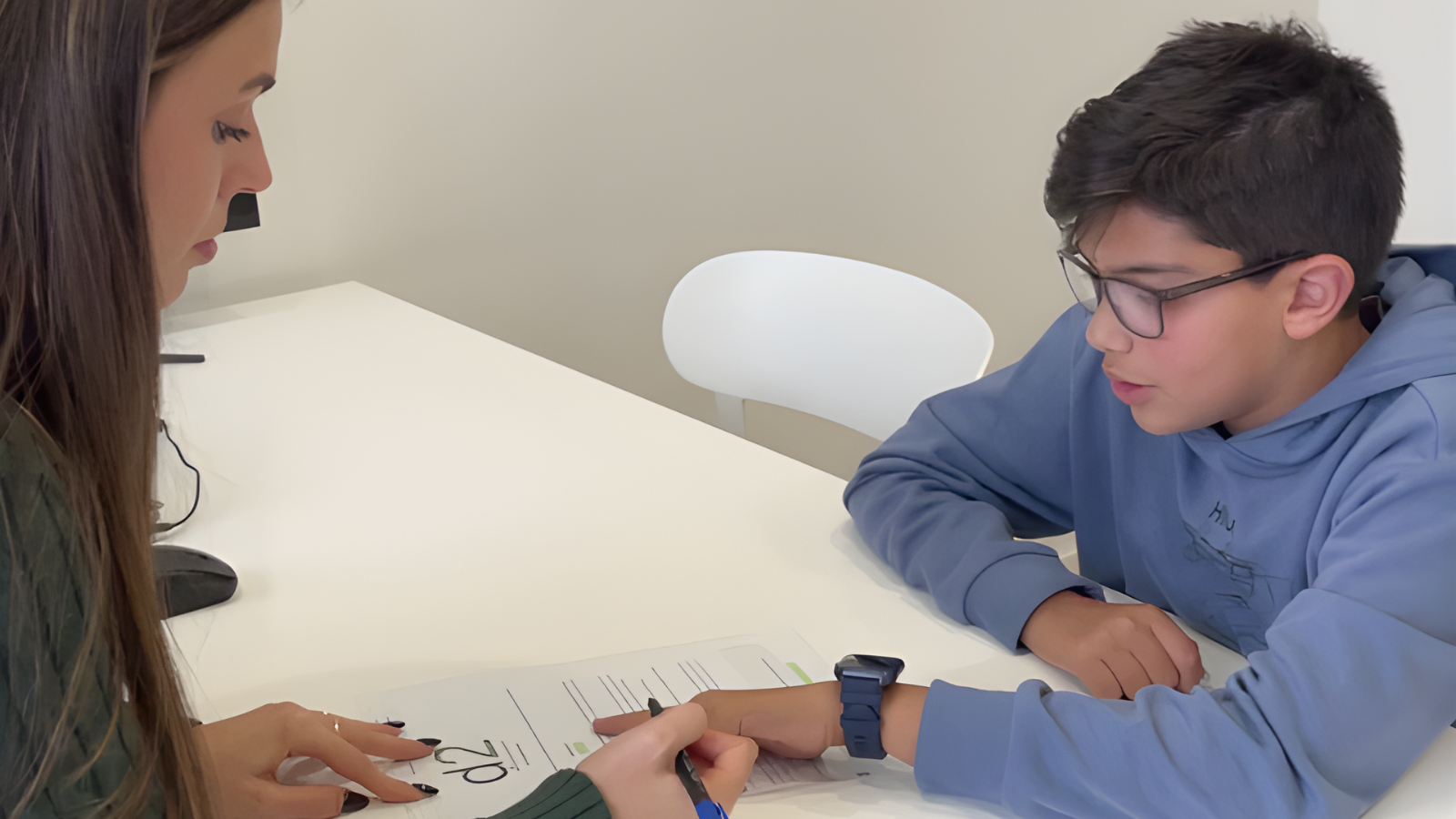
A capacity for attention plays a fundamental role in childhood and adolescence. Difficulties in maintaining focus, following instructions, remembering important information, or finishing simple tasks are sources of frustration for many young people, as well as a cause for concern for parents.
In this context, specialized intervention is key to assessing and uncovering the causes of these difficulties and, consequently, working with each child and adolescent on ways to overcome them.
In specialized support, methods are used to assess attentional and cognitive components, among which attention tests, such as the d2 test.
This article will focus on clarifying the purpose of the d2 test and its importance in the clinical process.
What is an attention test?
Attention tests are tools used in neuropsychology to assess the cognitive and attentional abilities of those who take them, allowing for the analysis of the speed and accuracy of attentional processing in visual discrimination tasks.
Although there are different types of "attention tests," each one can assess one or more specific components within the field of attention.
The d2 test, as will be explained in detail below, allows for the assessment of components of selective attention (the ability to focus on specific stimuli while ignoring irrelevant ones) and concentration capacity.
Thus, this tool becomes extremely important in the diagnostic process for disorders such as Attention Deficit Hyperactivity Disorder (ADHD), as it allows for the identification of patterns of inattention and impulsivity typically associated with this neurodevelopmental condition.
What does the d2 test evaluate?
In our follow-up, the d2 is administered during the first consultation for assessing children from 8 years of age onwards.
The professional begins this process by explaining what the child or adolescent will need to do. Here, they are given the opportunity to complete a short practice exercise to ensure that the instructions have been fully understood.
After the explanation, the test begins, where the individual faces two challenges:
👀 Visually
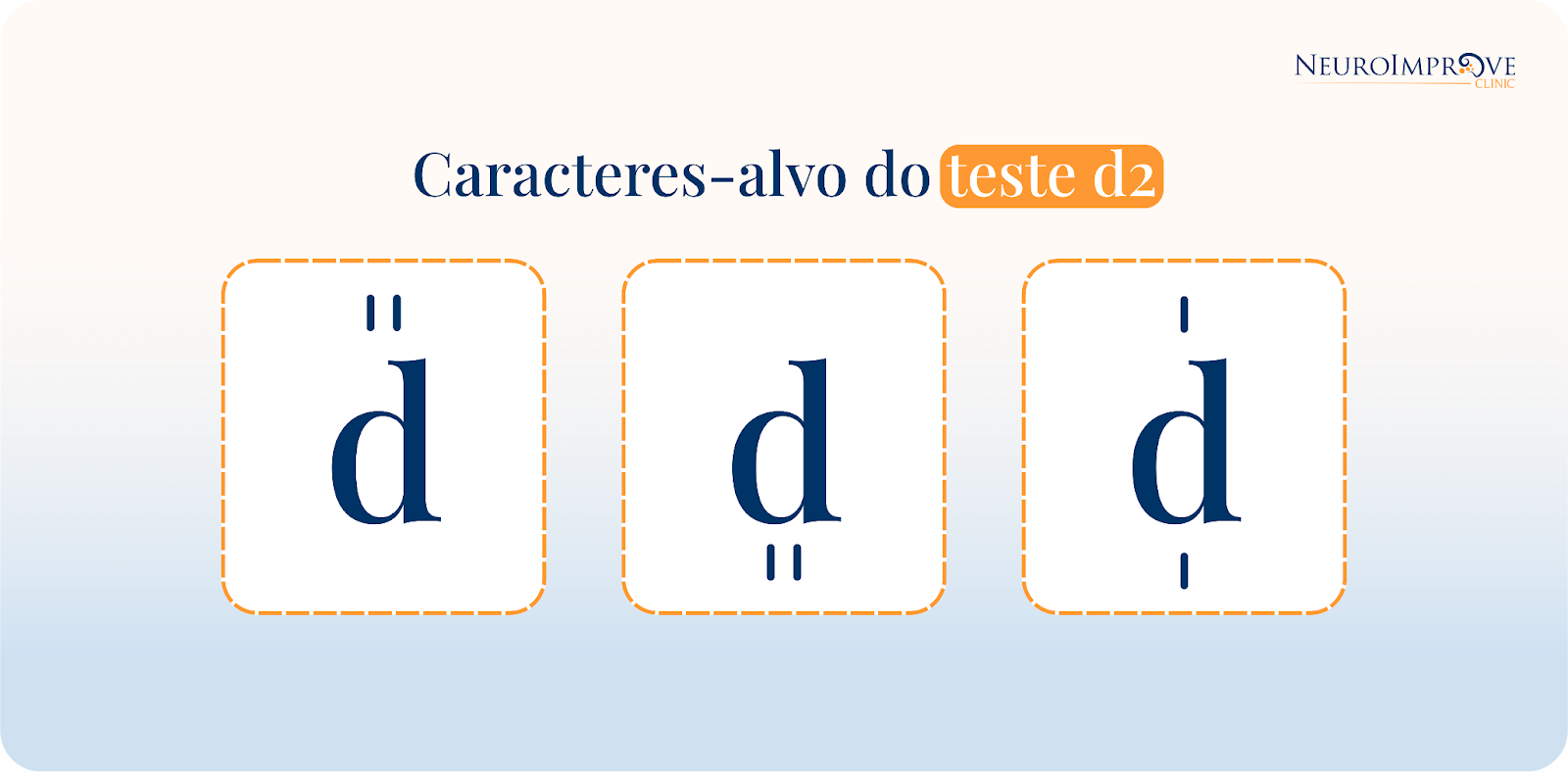
On a sheet filled with the letters “d” and “p”, each with small dashes above or below, the child or adolescent must identify and mark the letters “d” that have a total of two dashes (two on top, two on the bottom, OR one on top and one on the bottom).
The difficulty lies in avoiding the selection of distractors, namely:
- the letters “p”, which may also have those dashes;
- OR the letter “d” with one or three dashes, which, when mixed together, can really confuse the brain if it isn't 100% focused!
⏱️ In terms of time
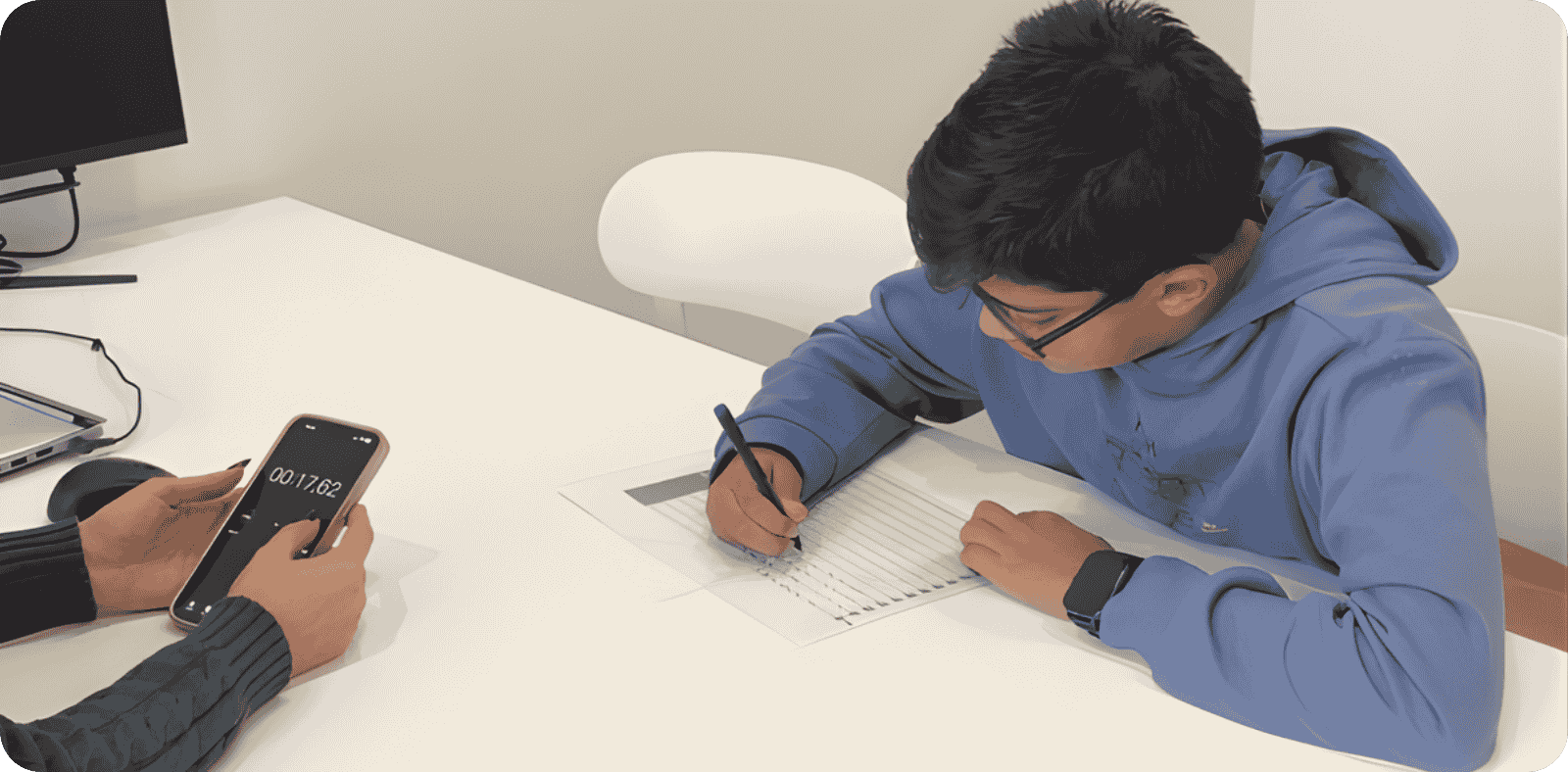
The child or adolescent has a total of 14 lines to analyze, with 20 seconds for each one.
Upon reaching the 20-second mark, the psychologist asks the individual to move on to the next line (regardless of whether they finished the previous one).
In this way, with this exercise, the professional is able to analyze:
- Productivity: how many letters the individual managed to process.
- Quality: of what was processed, how many correct letters were missed, and whether the individual marked any intruders/incorrect letters.
- Consistency: whether the quality of the responses remained the same from the beginning or if there was a drop in the number of correct responses.
We can immediately conclude that this is an extremely valuable element in understanding each child or adolescent because it allows the mental health professional to draw conclusions regarding:
- Selective attention
- Sustained attention
- Information processing speed
- Amount of work completed
- Accuracy and effectiveness
- Consistency and quality of performance
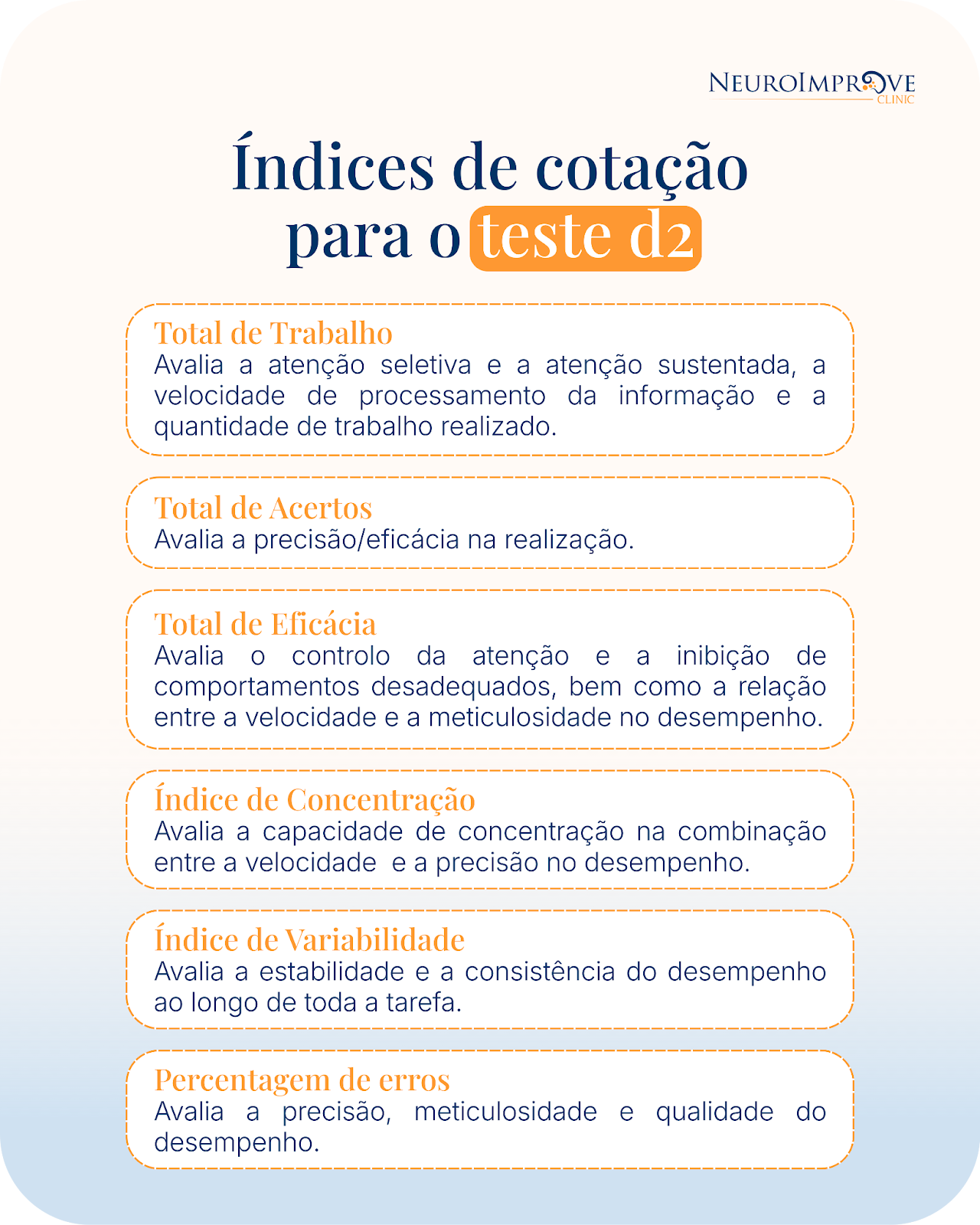
Ultimately, there is a quantitative and qualitative result based on scoring indices:
💯 Total Work
Assesses selective and sustained attention, information processing speed, and the amount of work completed.
✅ Total Correct
Assesses accuracy/effectiveness in performance.
✍️ Total Effectiveness
Assesses attention control and the inhibition of inappropriate behaviors, as well as the relationship between speed and meticulousness in performance.
🎯 Concentration Index
Assesses the ability to concentrate by combining speed and accuracy in performance.
📉 Variability Index
Assesses the stability and consistency of performance throughout the entire task.
❌ Error Percentage
Assesses the accuracy, meticulousness, and quality of performance.
This allows parents to understand the child's cognitive status. In other words, to see if there are issues regarding information processing, impulsivity, attention, and concentration.
Once difficulties are identified, they can be improved through ongoing clinical support.
Conclusions
✅ There are various types of attention tests that can evaluate different components in the field of attention.
✅ The d2 is a test of selective and sustained attention.
✅ A time limit is set for the individual to identify and mark specific symbols, while ignoring “distractors”.
✅ After completing the test, the professional can evaluate and score the exam, obtaining both a quantitative and a qualitative result.
✅ This tool allows mental health professionals to draw conclusions regarding the cognitive components and capabilities of the child/adolescent and identify potential areas of focus for clinical follow-up.
References
Brickenkamp, R. (2007). Manual d2 teste de atenção. CEGOC-TEA.
Treviño, M., Zhu, X., Lu, Y. Y., Scheuer, L. S., Passell, E., Huang, G. C., Germine, L. T., Horowitz, T. S. (2021). How do we measure attention? Using factor analysis to establish construct validity of neuropsychological tests. Cognitive research: principles and implications, 6(1), 51. https://doi.org/10.1186/s41235-021-00313-1
Related Content


We Train Brains, Strengthen Minds, Transform Lives
Schedule an appointment and see how we can help.
No time for a call now? Leave your details and we will get in touch:

Wonderful team, concerned, attentive and always available to help in everything.
With the passage of time, the results are being verified.
I am grateful to have met Neuroimprove and all its professionals.