
Diagnosis of ASD? The importance of understanding and embracing autism

I knew that, all over the world, 1 in 160 childrenDo you have Autism Spectrum Disorder (ASD)? These official data of SORESe da WHOshow us that this is a more common disorder than we imagine.
According to data from AIA (Support and Inclusion for Autism) existalmost 52 thousand people in Portugal with autism. These figures are equivalent to more than the total capacity of Estádio do Dragão, currently with a capacity of 50 thousand! 😯
These results reinforce the importance of continuing to raise public awareness about autism, promoting a greater dialogue about this condition that is present in children and adults and that requires responses adapted to their individual characteristics.
👉 In this blog article we will talk about precisely that: what is PEA, what are the signs and symptoms, how the diagnosis is made and how we can intervene.
What is PEA?
Autism Spectrum Disorder (or Autism only) is a neurodevelopmental disorder, which accompanies children and adults worldwide, throughout life. It presents a wide range of manifestations and is characterized by difficulties:
🔸 In social interaction 👥
🔸 In communication 🗣️
🔸 In behavior 🧍
🔸 Our interests ❤️
🔸 In the activities 📖
PEA does not manifest itself in the same way for everyone. In fact, the word”spectrum” represents just that: a diversitythe way symptoms and characteristics are manifested.
There are therefore different:
🔹Degrees of intensity(more or less pronounced cases)
🔹Affected areas(from communication, socialization, behavior, sensory sensitivity, among others)
🔹Cognitive abilities and language(there may be non-verbal people, with intellectual deficits, highly developed language or other cognitive abilities above average)
In addition to “Autism” and “Autism Spectrum Disorder (PEA)”, we can still refer to this condition as Autism Spectrum Disorder (ASD)- term in Brazilian Portuguese also widely used.
Autism: symptoms and characteristics
Second or DSM-5symptoms of PEAcan be identified in the second year of life(between 12 and 24 months).
However, in situations where there are obvious developmental delays, these signs may appear before 12 months. On the other hand, when they are subtle, they can only be identified after 24 months.
It is also possible that in the first two years of childhood, there is a gradual or sudden loss of skills such as language and social behaviors. Although not very common, it is a warning signfor early identification of PEA.
PEA, as we mentioned above, manifests itself in different ways, from individual to individual. Even so, there are quite common features, namely:
🧩 Difficulty starting and maintaining conversations.
🧩 Presence of repetitive gestures and little visual.
🧩 Difficulty in language and verbal and non-verbal communication.
🧩 Literal interpretation of the language.
🧩 Rigidity in thinking and difficulty in abstract thinking.
🧩 Difficulty in empathy.
🧩 Restricted and repetitive behaviors and interests.
🧩 Peculiarities in speech and language.
🧩 Hyper- or hyposensitivity (reduced sensitivity) to sensory stimuli.
🧩 Motor discoordination.
🧩 Difficulty in emotional regulation.
🧩 Absence (or difficulty in adapting) eye contact and facial expressions.
🧩 Difficulty sharing interests and activities.
These characteristics can arise in different combinations and intensities, making each person with PEA have a completely unique profile.

Causes for PEA
Causes of Autism Spectrum Disorder are still not very clear. However, some factors may be related to its development:
🌏 Environmental Factors - related to the older age of the parents, lower than expected birth weight or exposure to valproate during pregnancy.
🧬 Genetic Factors- related to heredity. In other words, autism can have a genetic origin and, in some cases, can be inherited in more than 90%. About 15% of cases are linked to known genetic mutations, but in the majority, the risk comes from the combination of different genes.
How is the diagnosis of PEA made?
The diagnosis of PEA is usually made between childhood and school age and requires a thorough, thorough and complete analysis. This evaluation is carried out by professionals, in which are analyzed:
🔹 The history of development.
🔹 Or family history.
🔹 Physical exams.
🔹 Genetic evaluation.
🔹 Metabolism tests.
🔹 Brain exams.
🔹 Clinically relevant behaviors in the child's life contexts.
The severity of the diagnosis is variable depending on the results found. It is currently considered3 levels of severity:
1 ️ ⃣ The level 1 that “requires support”.
2 ️ ⃣ The level 2 that “requires substantial support”.
3 ️ ⃣ Level 3 that “requires a lot of substantial support”.
In short: A severity of symptoms is variableand depends on the degree of functionality, need for support and ability to participate. Thus, its manifestation varies from individual to individual and the way in which it manifests itself also undergoes changes throughout life.
How can we intervene in PEA?
According to a study published by Yearly Reviews, interventions in Autism must be personalized responding to the different needs, difficulties and abilities of each person.
🎯 Regardless of these variables, the objective is common: improve social communication, relationships, autonomy, employment (in the case of adults) and mental health.
Early intervention is ideal because it allows an intervention that contributes to the improvement of adaptive skills and reduction of the severity of symptoms over time.
For Autism Spectrum Disorder, intervention at NeuroImprove involves:
- Initial Assessment with qEEG (Quantitative Electroencephalogram)
This exam allows us to understand the activity and brain functioning of the client.
- Psychological Assessment
Where our professionals use reliable psychological assessment methods to obtain a deep understanding of the client's history and current mental state, confirming the diagnosis.
- Results and Objectives
Based on the evaluations mentioned above, the results are analyzed and discussed with the client. Here, the therapeutic objectives aligned with the unique needs of the person are also defined together.
- Custom Protocol
It is established a customized treatment planwhich may involve sessions of Neurofeedbackand/or enquiries from Psychology. Continuous monitoring is ensured, and reassessments are carried out to understand the current conditions of the client and make the necessary adjustments.
- Support Network
To maximize the effectiveness of the intervention, there is collaboration not only with the family but also with the school (in the case of children) and other health professionals who may be involved.
Austimo and PHDA: can they be related?
The answer is: Sim.
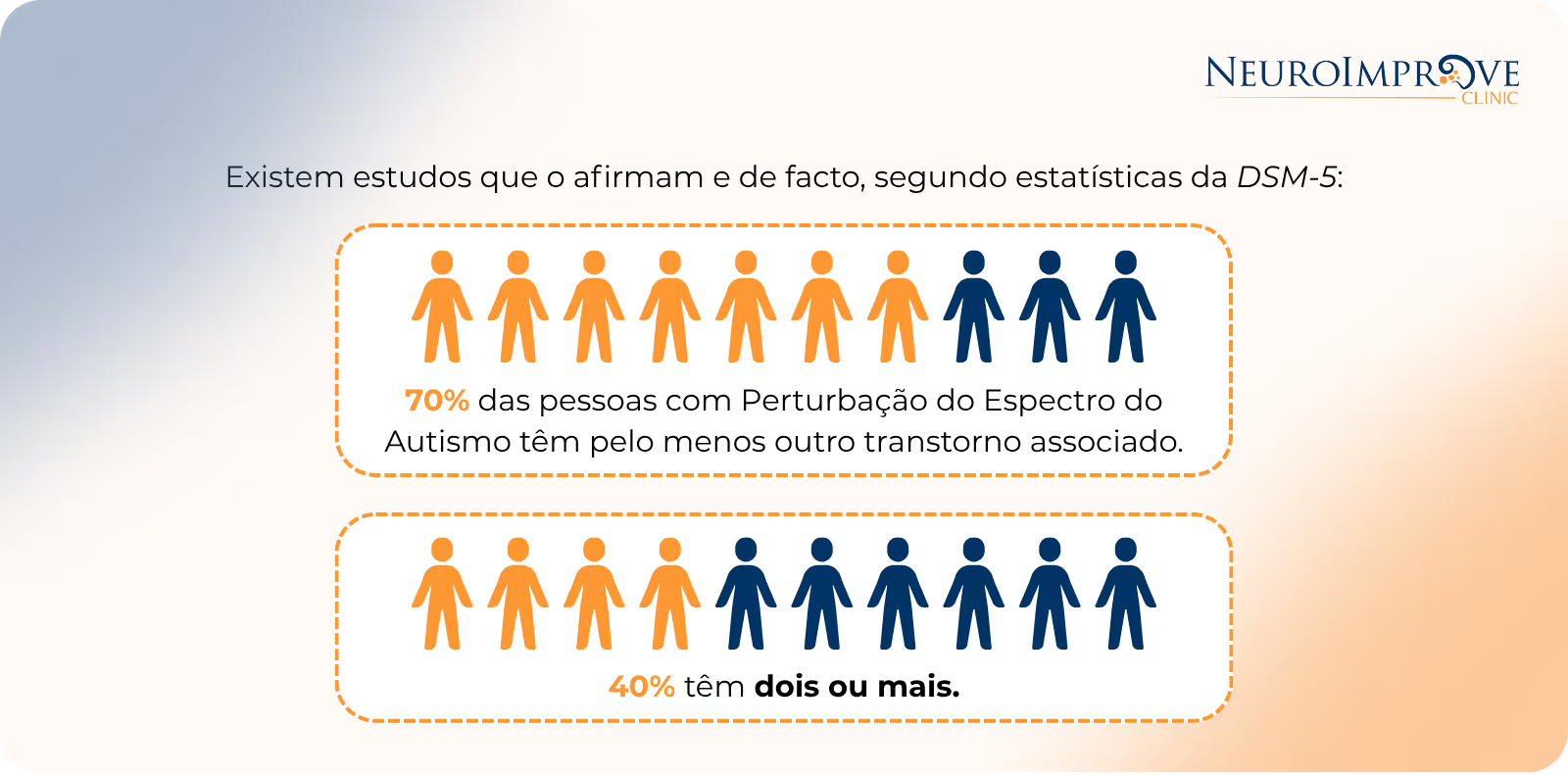
In the clinical context and in particular in relation to PHD(Hyperactivity Disorder and Attention Deficit Disorder), when the criteria for both conditions are true, the two diagnoses should be assigned to the person.
A study that compared diagnosed children with PHDA and PEAwith children diagnosed with PHDA alone concluded that,children with both diagnoses:
➡️ They have greater needs for treatment and support (outside and within the school context).
➡️ They are more likely to have other serious psychological problems, as well as worse outcomes in terms of school, family, social, cognitive and quality of life.
➡️ They have a more severe PHDA with higher levels of hyperactivity/impulsivity and inattention.
➡️ They have greater difficulties in terms of attention, emotional management and inhibition of behaviors in relation to children with only one of the diagnoses.
Final Considerations
Autism Spectrum Disorder (ASD) affects children and adults worldwide.
As we have seen, this disorder does not manifest itself uniformly, so each person is completely unique and their Individualities must be embraced, respected and understood.
Every child or adult with autism offers us a unique way of seeing and feeling the world. Promoting inclusion is opening a space where all minds have value and are truly welcomed. 💙
At NeuroImprove we embrace this individuality because we believe that they should be listened to, valued and strengthened. It is in this sense that we accompany each route in a personalized way, promoting the growth and mental balanceof all who seek us.
Would you like to know more about our intervention in the PEA? 🧩
In April, the so-called”Abril Blue”, it was autism awareness month! Our specialized Psychologist, Dra. Anabela Castro, told us a little about this together with 2 real cases that we had the opportunity to host in our clinic:
References
Support and Inclusion for Autism (AIA). https://www.aia.org.pt/
Autism Spectrum Disorder. (2013). Diagnostic and Statistical Manual of Mental Disorders Fifth Edition.
Lord, C., Elsabbagh, M., Baird, G., & Veenstra-Vanderweele, J. (2018). Autism spectrum disorder. Lancet (London, England), 392 (10146), 508—520. https://doi.org/10.1016/S0140-6736(18)31129-2
Tafolla, M., Singer, H., & Lord, C. (2025). Autism Spectrum Disorder Across the Lifespan. Annual review of clinical psychology, 21 (1), 193—220. https://doi.org/10.1146/annurev-clinpsy-081423-031110
Autism Spectrum Disorder. Pan-American Health Organization. World Health Organization Region of the Americas. https://www.paho.org/pt/topicos/transtorno-do-espectro-autista
Zablotsky, B., Bramlett, M. D., & Blumberg, S. J. (2020). The Co-Occurrence of Autism Spectrum Disorder in Children With ADHD. Journal of attention disorders, 24 (1), 94—103. https://doi.org/10.1177/1087054717713638
Related Content


We Train Brains, Strengthen Minds, Transform Lives
Schedule an appointment and see how we can help.
No time for a call now? Leave your details and we will get in touch:

Wonderful team, concerned, attentive and always available to help in everything.
With the passage of time, the results are being verified.
I am grateful to have met Neuroimprove and all its professionals.