
Entrepreneurship with ADHD (Interview with Luísa Cabral)

.avif)
At NeuroImprove, we strive to share knowledge about PHD, its consequences and management strategies. However, nothing compares to the richness of a personal account like Luísa's, which reflects the daily challenges and victories of those who live and venture with this complex condition.
👉 Are you in a hurry? Go straight to what interests you most:
<h2 id="luisacabral">Who is Luísa Cabral?</h2>
Luísa Cabral, founder of Alanja Handmade, shares her life experience with ADHD (Attention Deficit Hyperactivity Disorder) and the impact of a late diagnosis.
Passionate about manual activities, she found in crochet and amigurumi a way to express herself and build her own business.
Today, Luísa not only inspires the artisan community, but also seeks to promote greater awareness about PHDA in Portugal.
<h2 id="percurso">Professional Course and Beginnings in Handicrafts</h2>
🧠 NeuroImprove:To begin with, Luísa, can you tell us a little bit about your history and your journey so far?
🧶 Luisa:I completed my degree in Audiovisual and Multimedia in Lisbon. I was always an average student — I never had any negatives, but I wasn't the best in the class either. I grew up in an environment where academic performance was seen as essential, which generated a lot of pressure. However, I felt like I had to try twice or triple the others, and even so it ended up in the middle of the table.
When I finished my bachelor's degree, I found a bleak job market. At that time, my partner and I decided to open a video producer, the Shortfuse. It was not easy. What ended up working was the combination of my impulsive side with his organization. We used to joke that I'm the chaos he needs, and he's the calm I need.
Manual work has always been a part of my life. Like many people with PHDA, I had many hobbies: cross stitch, embroidery, acrylic painting, crochet, tricot, missangas, clay, sewing... But crochet has always had a special place for me - when I was 7 years old, my grandmother taught me.
I did not stand still, and both my mother and my grandmother, when they realized that this helped me focus, they always encouraged me to continue (crochet).
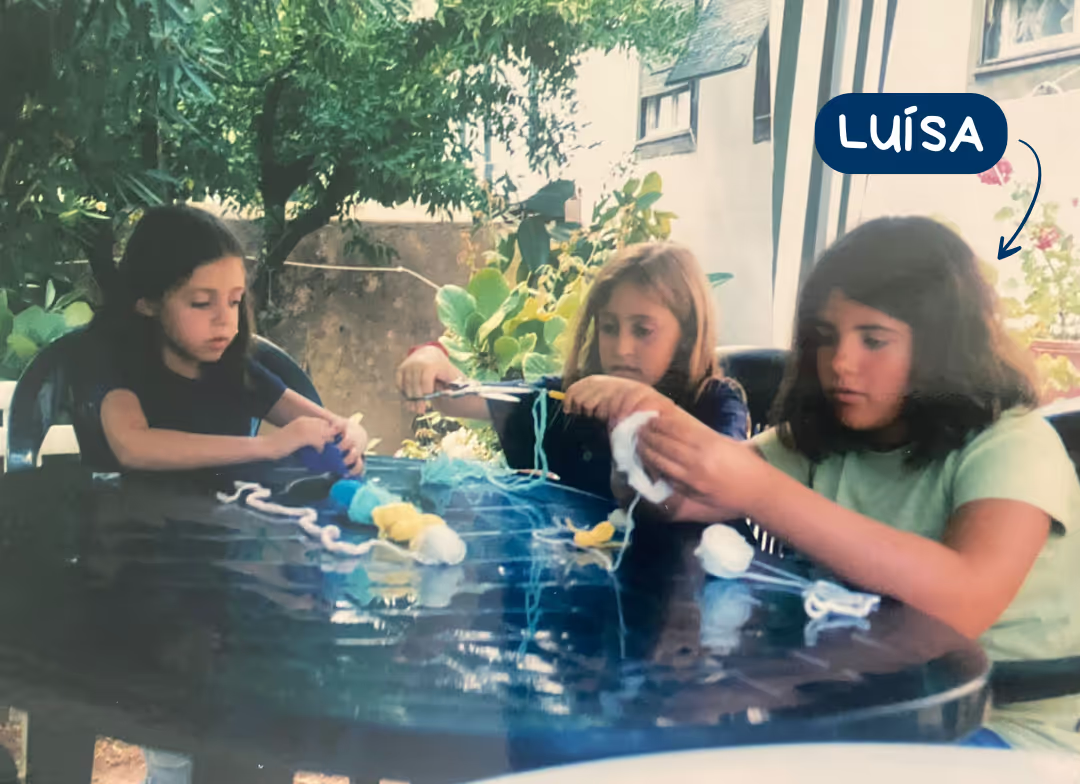
Later, at school, crocheting was not something 'fixed', so I did it a little on the sly. It was only in college that I went back, learned more advanced techniques on the internet and made my first amigurumi.
When the pandemic started, felt a lot of anxiety and uncertainty, and I went back to making more amigurumi as a way to relax and spend time at home. I spent hours trying to improve. With the encouragement of my husband and friends, I created the Alanja Handmade page, where I started sharing my creations and connecting with the crochet community.
My mind was completely focused on this interest, and I had difficulty concentrating on work. I realized that perhaps the best path would be to follow my interest in crochet and turn it into a business. So, since January 2023, I dedicate myself full time to Alanja.
Today, in addition to creating my own models and selling tutorials, I work with some brands, I have already given classes to children, I have done workshops, I have participated in craft fairs, and I also do consulting and content creation. It is a challenge, because I need to manage several sources of income at the same time. But, for one brain that always wants new and different things, I don't think I could have chosen a better job!
<h2 id="diagnostico">Diagnosis of PHDA in Adult Life</h2>
🧠 NeuroImprove:How was it to receive the diagnosis of PHDA in adulthood?
🧶 Luisa:The process was very lonely for me. In elementary school, the teacher already thought that something was wrong with me. I could not sit still in the chair, I would not pay attention in class, I would get up to go and sit on the teacher's neck, damn...
My mother even took me to do psychological tests, but in the 90s I didn't know that much. They told him that I was hyperactiveand advised her to put me in sports (which I never liked very much) and manual activities. Later, my mother confessed to me that, in elementary school, they asked for permission to put my table and chair on the floor, so that I would not distract the other students.
Distraction, lack of time, disorganization and procrastinationhave always been part of my life. But I thought it was a problem with my personality, that I was always failing, and that I would never be good enough.
In 2018, with the birth of my daughter, I lived one of the happiest moments of my life, but also one of the most difficult. I had postpartum depression, and sleep deprivationit affected me so much that I looked like a zombie. I was completely apathetic.
In 2020, during confinement, I started to get worse, feeling more and more drowned. That's when I started therapy. I improved a lot, but after 2 years I still felt that there was something to discover. I became interested in mental health and I went into hyperfocus, researching everything about mental illness. That's when I came across videos on social media about PHDA, and I identified with other people's experiences. However, I was ashamed to say to a doctor, 'I think I have this because I saw some videos. ' So I looked for all the scientific content, and things made more and more sense.
I gained courage and told my psychologist that I thought I had PHDA. Although he was not familiar with the subject, he researched the subject, tested me and referred me to a psychiatrist. I think that the fact that I looked 'functional' in the eyes of society - having a degree, a company, a daughter, a stable relationship - masked the suffering and the effort that I made to be like the others.
When the psychiatrist confirmed the diagnosis, it was a validation of what I felt. I remember that, when I took the medication for the first time, I was at home with my daughter and I started crying... It seemed like, for the first time, I could really hear what she was saying to me. That moment was transformative for me.
Realizing that I wasn't a bad person or a bad mother, but that my brain just didn't work like everyone else's. And it's all right with that!
<h2 id="desafios">PHDA Challenges and Organization</h2>
🧠 NeuroImprove:What are the main difficulties you face on a daily basis due to PHDA?
🧶 Luisa:My biggest difficulty is staying organized and dealing with so many things at the same time. In addition, my thoughts are often faster than mine speak. It made me feel a disconnect between what I was saying and what I was thinking. Today, with medication, this does not happen so much anymore, but before I thought that I had said something in a conversation, when in fact I had only thought and did not manage to communicate to the other.
🧠 NeuroImprove:What strategies or tools do you currently use to manage your business and keep your personal life organized?
🧶 Luisa:One of my biggest challenges is, without a doubt, organization. I still feel that I do not have all the strategies I need to 'function' as I would like. But here are some of the ones I use:
- I write down EVERYTHING on my calendar, from coffee with friends to birthdays and work commitments.
- I installed an app (Toggle Track) in which I activate the stopwatch and record the tasks I am doing. So when I need to repeat something similar, I can look at the time that task took and have a more precise idea of the time.
- One of the hardest things was taking the right medication every day. I bought a box of pills with the days of the week, and now she lives next to the coffee machine. So whenever I take my coffee, looking at the box automatically reminds me to take the pills.
- All the monthly payments I have to make are scheduled for automatic payment. Otherwise, I would never remember to make them!
- When I plan my week, I always try to leave one day free, with no scheduled commitments. So if I'm procrastinating on a task or if I can't be as productive as I'd like, I have that extra time planned.
- I bought a smartwatch that shows me only the essential notifications of the phone, so I can quickly look and decide if something is important enough to interrupt what I am doing.
<h2 id="impacto">Impact of Manual Activities on Mental Health</h2>
🧠 NeuroImprove: His business is focused on manual activities such as crochet and amigurumi. How have these activities helped improve your mental health?
🧶 Luisa:Manual activities have helped me improve concentration and focus because they require attention to detail and a sequence of repetitive movements that calm the mind - what is known today as Mindfulness.
In addition, these moments of creation function asa form of active meditation, which has done a lot to reduce stress and improve my mental health. It has always helped me regulate my PHDA symptoms and make me appear to be a “functional” adult, even before I was diagnosed with PHDA.
🧠 NeuroImprove: Would you recommend these manual activities to other people with PHDA? What benefits did you notice in your routine and well-being?
🧶 Luisa:I highly recommend manual activities for those with PHDA. They are a great way to express ourselves creatively (and, in general, we are very creative people!) and help calm the mind.
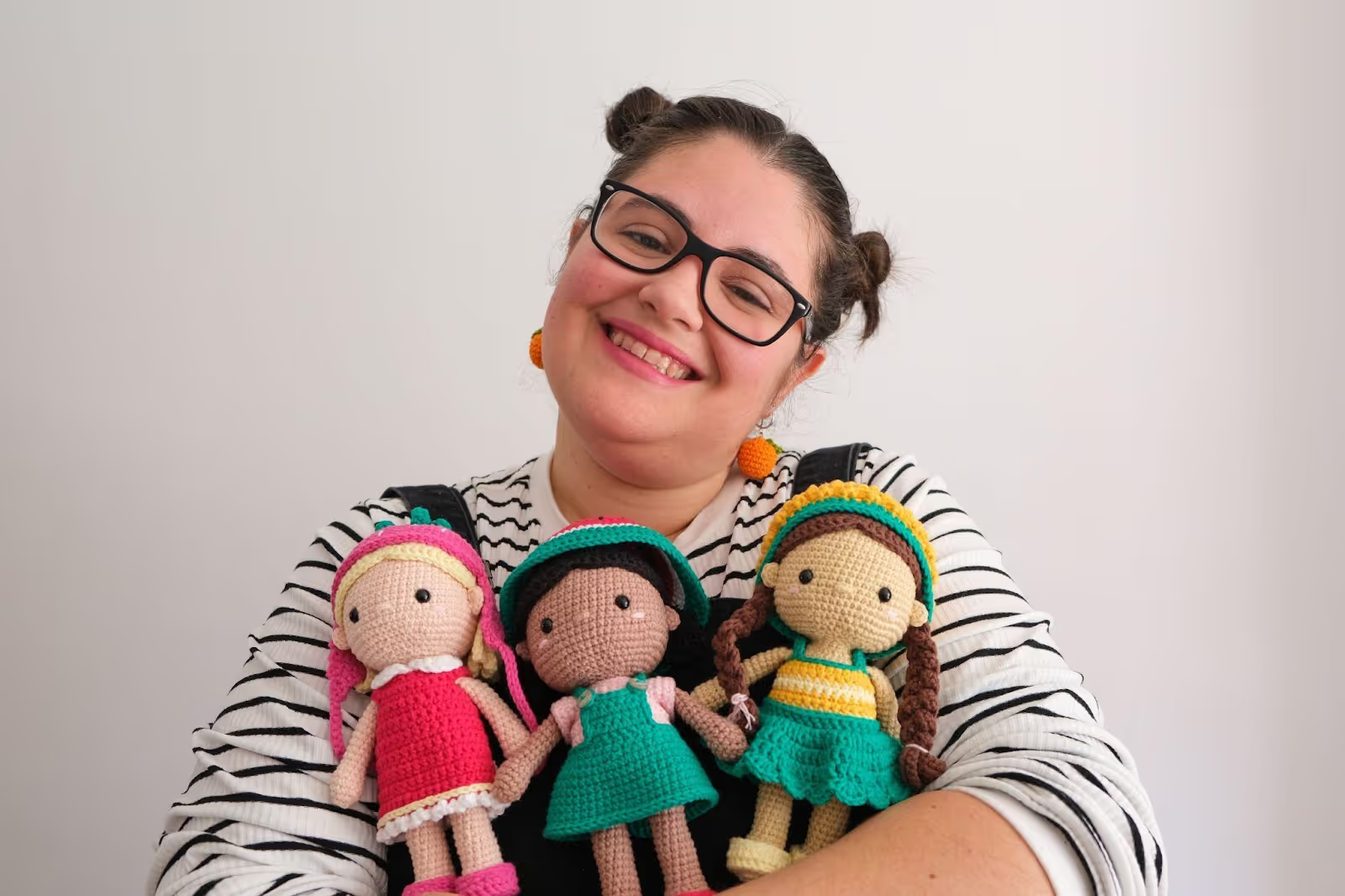
When I'm working on an amigurumi or a crochet piece of clothing, watching the piece grow and gain shape helps me stay focusedand wanting to continue the project, because I can see the progress in front of me. In addition, both tricot and crochet are quite portable, which makes it easy to always have a project in your bag and work a little at any time of the day.
<h2 id="conselhos">Advice and Inspiration for Women with PHDA</h2>
🧠 NeuroImprove:In Portugal, there is still little information and awareness about PHDA, especially among women. Did you feel a lack of resources and support when you were diagnosed? How do you deal with that?
🧶 Luisa:I feel that, in Portugal, we are just now starting to talk more about this subject! When I did my research to try to understand what PHDA was, I was only able to find information in English or Portuguese from Brazil. I realized that many adults diagnosed late are women, because in childhood our symptoms tend to be different from those of men.
I lacked a lot of support to find out I had PHDA, it was a lonely journey. For society, I was 'normal'. If I hadn't searched incessantly for answers, I probably never would have discovered what I had.
I also realized that there is still little talk about the connection between female hormonal cycles and the influence they have on medication, and there are still not enough studies on the impact of pregnancy and postpartum on women with PHDA.
I believe that it is very important to share this information in Portuguese from Portugal. I hope this helps other people, like me, to realize that maybe there is something really wrong and that it is not our fault!
🧠 NeuroImprove: What advice would you give them, especially those who are trying to balance their personal and professional lives?
🧶 Luisa:Always seek to obtain more information, and do so from credible sources. PHDA can manifest itself in different ways in each person, so even if your symptoms are different from other people's, it doesn't mean you don't have the disorder.
Professionally, I believe that working in an area that gives us pleasure and motivation, on a personal level and not only financially, helps us achieve better results. In addition, when we partner with people with skills complementary to ours, we are able to create amazing things and find solutions where no one else sees.
<h2 id="equilibrio">Balance between Work Life and Motherhood</h2>
🧠 NeuroImprove: How was it for you to balance motherhood with diagnosis and your business? Have you found any way to use this diagnosis to better connect with your child?
🧶 Luisa:It was essential for me to have this diagnosis, because improved my relationship with my daughter a lot. I began to be more present to her, to understand her better, and now that she is start the first year of school, I can see that he has very similar traits to mine (he probably also has PHDA, but he does not have the diagnosis yet). This has helped me find strategies that help her perform better in school and create routines that give her the structure she needs — something I felt was missing many times in my life.
🧠 NeuroImprove: Is there any advice you would give to other mothers, especially those who may be going through a similar situation, either with their own diagnosis or with their children?
🧶 Luisa:If you feel that something is not right, do not give up looking for answers and wanting to know more. Even if the doctors say 'but you're very smart' or 'that's a child thing, 'they don't give up. They spent many years looking for what I needed to feel good about myself, and we are always in time to change. Be it 20, 30, 60 or 80 years old! We have the right and the duty to feel good so that we can help those around us.
In the case of children, if you think something is wrong with your children, try to find out why, even if you need to consult more than a health professional.
Early diagnosis can make a big difference, preventing other associated diseases and preventing your children from feeling, as I felt, that they are inferior to others.
They are very dependent on us at this stage, and if we can help them early on to find tools to deal with PHDA, they will be better prepared for a bright future, becoming functional and healthy adults in society.
<h2 id="futuro">Hopes for the Future</h2>
🧠 NeuroImprove: Finally, what do you expect for the future? How do you see Alanja's growth, and its role as a voice for people with PHDA in Portugal?
🧶 Luisa:I would like my project to inspire other people, especially women, to work with handicrafts, to be independent in their professional path, to create beautiful pieces and to practice mindfulness. I believe that it is essential that we know more about the lives of people with PHDA and that, even facing difficulties, we can have a full and happy life!
For me, Alanja is the manifestation of my creativity and my hip ideas. If I can inspire someone to learn to crochet, to create their amigurumi or not to give up on their dreams, then my job will be done! 🙂
We thank Luísa for sharing her authentic and inspiring experience with us. Your journey is a valuable example for all who seek to understand and live better with PHDA!
Related Content


We Train Brains, Strengthen Minds, Transform Lives
Schedule an appointment and see how we can help.
No time for a call now? Leave your details and we will get in touch:

Wonderful team, concerned, attentive and always available to help in everything.
With the passage of time, the results are being verified.
I am grateful to have met Neuroimprove and all its professionals.