
Burnout: the emotional, physical and mental exhaustion that few realize



Considered one of 21st century epidemics, Burnout is more common than we think.
💭 Let's start with a small reflection: have you ever felt that you have lost control of your work? Have you ever felt constant pressure, for long periods of time to, for example, meet deadlines? Have you ever felt that you had such an exhaustive work routine to the point of waking up in the morning without motivation to face the rest of your day?
These may be some signs that you are facing or have already faced a burnout situation.
In this blog article, we reflect more in depth on what a burnout is, the associated symptoms, as well as suggestions on how to intervene.
What is a burnout?
Burnout is currently recognized by International Classification of Diseases (CID-11)of the World Health Organization as a syndrome resulting from chronic stress in the workplace (which ceases to be momentary or punctual and becomes constant). It is characterized by three dimensionsThe main ones:
- Feelings of exhaustion or exhaustion of energy;
- Increased mental distance, feelings of negativism or cynicism related to the work itself;
- Reduction of professional effectiveness.
It thus manifests itself as a state persistent emotional, physical and mental exhaustionwhich develops when demands arise and the resources to meet them - such as time, support or recognition - are insufficient.
According to a study published in PLOS One,prolonged exposure to this syndrome may serious health impacts, such as the development of cardiovascular diseases, sleep problems, low immunity, among other complications that compromise general well-being.
Although they can often be confused, burnout and exhaustion are not exactly the same thing. However, understanding their differences is important for a more accurate diagnosis.
Burnout and exhaustion: what do they consist of and what are they different?
What are the differences between these two conditions?
O exhaustionis associated with short periodsof intense stress. It is an acute response to emotional, physical or mental demands that can occur in different contexts of life.
We can compare it to a warning light 🚨 - an indication that we need to slow down and make a change in our routine and lifestyle.
Yes the Burnout, it's a bit more complex. It is linked to the professional context and is developed when we are exposed to intense stress bylong periods of time. It is a deeper condition with greater repercussions for our general well-being.
What are the signs of exhaustion? What about burnout?
When we are exposed to excessive pressure, our body and mind give signals that something is not right. These signs are a warning that it is necessary to stop and try to restore the balance within us.
You may be wondering, “How do I know if I'm burnout or burnout? What are the signs I should watch out for?
Both conditions share the same symptoms, distinguished byIntensityand, as we have seen before, in your origin. Symptoms can vary from person to person, but both affect quality of life and emotional well-being.
For a better visualization and understanding of this distinction, we can resort to a simple comparison with the signaling of a traffic light 🚦:
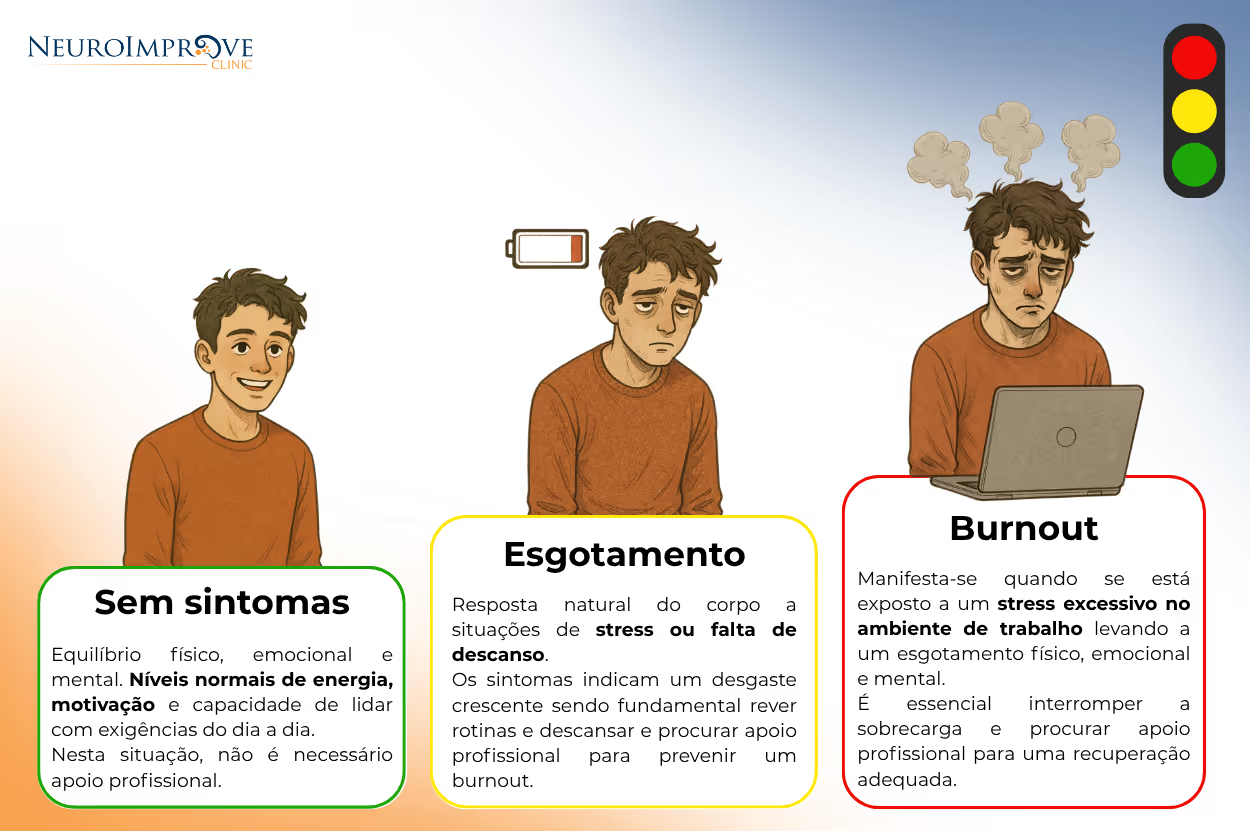
This analogy allows us to understand that exhaustion is a sign that something needs attention and that burnout represents something with more serious and lasting consequences!
Being attentive and recognizing the signs is essential to act in good time and prevent symptoms from getting worse:
🔹 Constant fatigue -Feeling of exhaustion even after a good night's sleep;
🔹 Difficulty concentrating -Simple tasks become difficult and forgetfulness becomes frequent;
🔹 Irritability and mood swings -There are mood swings and the person can feel irritated or impatient very easily;
🔹 Lack of motivation -Loss of interest in previously pleasurable activities;
🔹 Overload Sensation -Everything seems excessive, from responsibilities, to tasks and decisions. Feeling of inability to achieve goals;
🔹 Sleep Problems - Insomniaand sleepless nights. Sleep ceases to fulfill its restorative function;
🔹 Social isolation -Need to be alone avoiding conversations or gatherings;
🔹 Depersonalization -Distancing and emotional indifference in relation to work and other people;
🔹 Loss of professional sense -Disconnection with the professional purpose and doubts about one's own usefulness in the company;
🔹 Feeling of being trapped in an endless cycle - Feeling trapped in a negative routine. The person thinks that he will not be able to do a good job;
🔹 High self-criticism and low self-esteem -The person feels that he is constantly failing or that what he does is not enough;
🔹 Chronic exhaustion and resistance to rest -The mind is constantly accelerated and stopping only generates feelings of guilt;
If, in some way, you can identify with several points described here, perhaps it is time to stop and think about what your body and mind are trying to convey. The good news is that there are ways to recover and the first step is the recognition.
How to prevent and treat burnout syndrome
Recognizing that we are going through a challenging period that is affecting us on many levels can be difficult. However, this is the first step: recognize the problem and make a change.
The healing process requires time and above all empathy for us - to be able to understand that it is necessary to slow down the routine and change our priorities to give the body and mind exactly what they need: rest and professional support.
How to prevent burnout
As far as prevention is concerned, it is important, at an early stage, to put in place Healthy Boundaries. There are, therefore, some strategies that can help minimize symptoms and promote greater well-being:
🔸 Recognize your own limits - It is important to learn how to say “no” - from refusing an extra task or redefining deadlines.
🔸 Identify the main stress factors - It is essential to introspect and understand what is causing the greatest wear and tear and to look for ways to deal with these sources - and if possible reduce them;
🔸 Resume pleasurable activities/hobbies - Resuming activities that previously brought us joy or exploring new hobbies is a way to promote what makes us good. From reading, painting, cooking or playing sports, that is, activitieswhich promote fun;
🔸 Include self-regulation practices - It is important to resort to exercises that promote our balance. From breathing exercises, muscle relaxation, Mindfulnessor even meditation;
🔸 Talk to someone you trust - From a colleague, friend or family member, verbalizing what we feel helps organize our thoughts and can give us new perspectives. Choose someone you trust.
🔸 Establish a healthy sleep routine - People with burnout often experience insomnia or sleep poorly. Create consistent sleep habits and avoid screens before bedtime;
🔸 Take breaks at work - Breaks help reduce mental overload and increase productivity in the long run. Techniques such as method Pomodoroor just getting up to stretch your body and take a deep breath, they can make a difference.
These conditions, combined with a good work environment, are key to preventing the development of burnout syndrome.
How to treat burnout
The treatment, in addition to implying a structural changein certain aspects of a person's life, it also involves support and monitoring by specialized professionals.
At NeuroImprove, we recognize that the Burnout experience needs to be approached as unique because each person is different and has their own life story. Therefore, our approach iscustomized to individual needs.
A Cognitive-Behavioral Therapy is the basis of our inquiries Psychology, which allows you to develop self-knowledge and learn to establish healthy limits and habits so that each person finds the balance between personal and professional life. In addition, stress management techniques are transmitted, including attention and relaxation exercises for greater performance and emotional management.
Allied to Psychology consultations, there is the Neurofeedback which uses quantitative electroencephalogram (qEEG) results to identify imbalances in brain activity and correct them.
A study published in BioMed Research International, demonstrates that there may be specific changes in the brains of people with burnout - reinforcing the effectiveness of qEEG in their diagnosis.
With the course of the Neurofeedback sessions, some improvements will be noticeable such as greater mental clarity and emotional stability.
Is there a relationship between burnout and PHDA?
Yes, the people who live with Attention Deficit Hyperactivity Disorder(PHDA) are more vulnerable to developing Burnout Syndrome.
According to a study in AIMS Public Health,difficulty in executive functions - such as self-organization, time management, problem solving and working memory- can lead to the development of burnout.
In addition, the chronic stress associated with this syndrome tends to inevitably aggravate the symptoms of PHDA, creating a cycle that is difficult to break without adequate support. In this form, treat PHDA It also helps to alleviate the symptoms of burnout as there is a reduction in the factors that contribute to emotional and mental exhaustion.
Final Considerations
👉 Burnout can begin to manifest itself unnoticed, however, with the passage of time and with the aggravation of symptoms, it damages both health and quality of life.
When we are faced with a situation like this, the professional support is indispensableso that it is possible to regain the balance of our lives and to find purpose again.
Cognitive-Behavioral Therapy and Neurofeedback are two allies that allow not only a direct action on our brain, but also an orientation at the mental, emotional level and in the journey of self-knowledge.
Remember that prevention starts with imposing healthy limits and that the balance between the two spheres - personal and professional - must never be forgotten. ⚖️
References
Golonka, K., Gawlowska, M., Moss-Kaja, J., Marek, T. Psychophysiological Characteristics of Burnout Syndrome: Resting-State EEG Analysis. BioMed Research International. 2019, 3764354, 8 pages, 2019. https://doi.org/10.1155/2019/3764354
Pan-American Health Organization (PAHO). CID: burnout is an occupational phenomenon (2019). https://www.paho.org/pt/noticias/28-5-2019-cid-burnout-e-um-fenomeno-ocupacional
Boss, D. (2024) A Systematic Review Examining the use of Neurofeedback as an intervention in the Management of Burnout. University of the Witwatersrand Johannesburg.
Salvagioni, D. A. J., Melanda, F. N., Mesas, A. E., Gonzalez, A. D., Gabani, F. L., Andrade, S. MR. (2017) Physical, psychological and occupational consequences of job burnout: A systematic review of prospective studies. PLoS ONE 12 (10): e0185781. https://doi.org/10.1371/journal.pone.0185781
Turjeman-Levi, Y., Itzhakov, G., Engel-Yeger, B. Executive function deficits mediate the relationship between employees' ADHD and job burnout. AIMS Public Health, 2024, 11 (1) :294—314. doi: 10.3934/publichealth.2024015
Yasmin, K., Yaqoob, A., Sarwer, H. (2022). Effect of Cognitive Behavioral Therapy (CBT) Based Intervention on Resilience and Burnout among Staff Nurses Working in Critical Care Departments. Pakistan Journal of Medical & Health Sciences, 16 (03), 295. https://doi.org/10.53350/pjmhs22163295
Related Content


O cérebro fala.
Nós ouvimos.
Schedule an appointment and see how we can help.
No time for a call now? Leave your details and we will get in touch:

Wonderful team, concerned, attentive and always available to help in everything.
With the passage of time, the results are being verified.
I am grateful to have met Neuroimprove and all its professionals.