

Throughout our lives, we are constantly exposedpressures, changes, decisions and complex relationships. In the middle of this, understand what we feel (and why), becomes essential to deal with day-to-day challenges. It is in this context that Emotional Intelligence gains relevance.
Develop Emotional Intelligencemeans to find a balancebetween feeling and thinking. It is a skill that can not only be learned, but also cultivated over time.
In this article, we teach that it is competence available to all, should be constantly practiced. 💭
What is Emotional Intelligence?
Oliver Serrant states that a Emotional Intelligence is the ability, ability or competence of identify, evaluate and manage our emotions, of others and of groups.In addition, people with a high degree of Emotional Intelligence have a high level of self-knowledge and are also able to feel and understand the emotions of the people around them.
It is much more than “managing feelings” - it involves a deep understanding about how emotions influence our behavior, decisions and interactions.
By developing Emotional Intelligence, it is possible to become more productive and successful, but also help othersto also be productive and successful. As such, this can have positive impacts on both the work environment and interpersonal relationships - the trend is that there is a greater capacity for conflict management, more effective communication and adaptation to change.
What does Emotional Intelligence consist of?
Emotional Intelligence is one toolingto achieve a more balanced life in the various spheres of our life.
By acquiring the ability to identify, manage and understand the emotions of third parties, it can have a direct impactin our decisions, in the way we face challenges and adversities or even in the way we look at the world around us.
In practice, Emotional Intelligence helps us to:
🔹 Make more thoughtful and conscious decisions;
🔹 Reduce or stressand increase emotional resilience;
🔹 Improve communication and build more empathetic and collaborative interpersonal relationships;
🔹 Increase motivation and focus on a personal and professional level.
It is a way to improve our well-being and also a advantage in any social, academic or professional context.
How does Emotional Intelligence work?
Emotional Intelligence works through balance between rational thinking and emotional response.This makes us capable avoidreact automatically to situationsbased on emotions and also thereduce to impulsivity.
This happens in two main levels:
👉 Internal- there is a recognition of one's own emotions, an understanding of their origin and the ability to regulate them, avoiding for example an explosion of negative emotions or blocked by anxiety.
👉 External- there is a reading of other people's emotions through facial expressions, tone of voice or body language and adapt to communication demonstrating empathy and respect.
Reading emotions allows you to give meaning to relationships making them clearer, authentic and effective.
How can Emotional Intelligence be developed?
As already mentioned, Emotional Intelligence is a skill that can be developed with practice, dedication and focus. Alguma strategiesthat can help you develop the degree of Emotional Intelligence:
🔸Practicing self-awareness- Reserve moments to reflect on what we are feeling and why.
🔸Exercise self-control- Learn to respond consciously instead of reacting. Conscious breathing or meditation helps to gain space between stimulus and response.
🔸Develop empathy - Learn to listen to others by putting yourself in their place, without judgment;
🔸Improve communication - Try to be clear and express what you always feel with respect and assertiveness;
🔸Be open to opinions - Understand the perception of others in relation to our behavior. This practice helps us grow and adjust what is needed.
The development of Emotional Intelligence takes time, reflection and continuous practice.
The 5 pillars of Emotional Intelligence
Second Oliver Serrante, people have different personalities, needs, desires and ways of showing their emotions.
Daniel Goleman, author of the book Emotional Intelligence, built a model that divides Emotional Intelligence into 5 pillars:
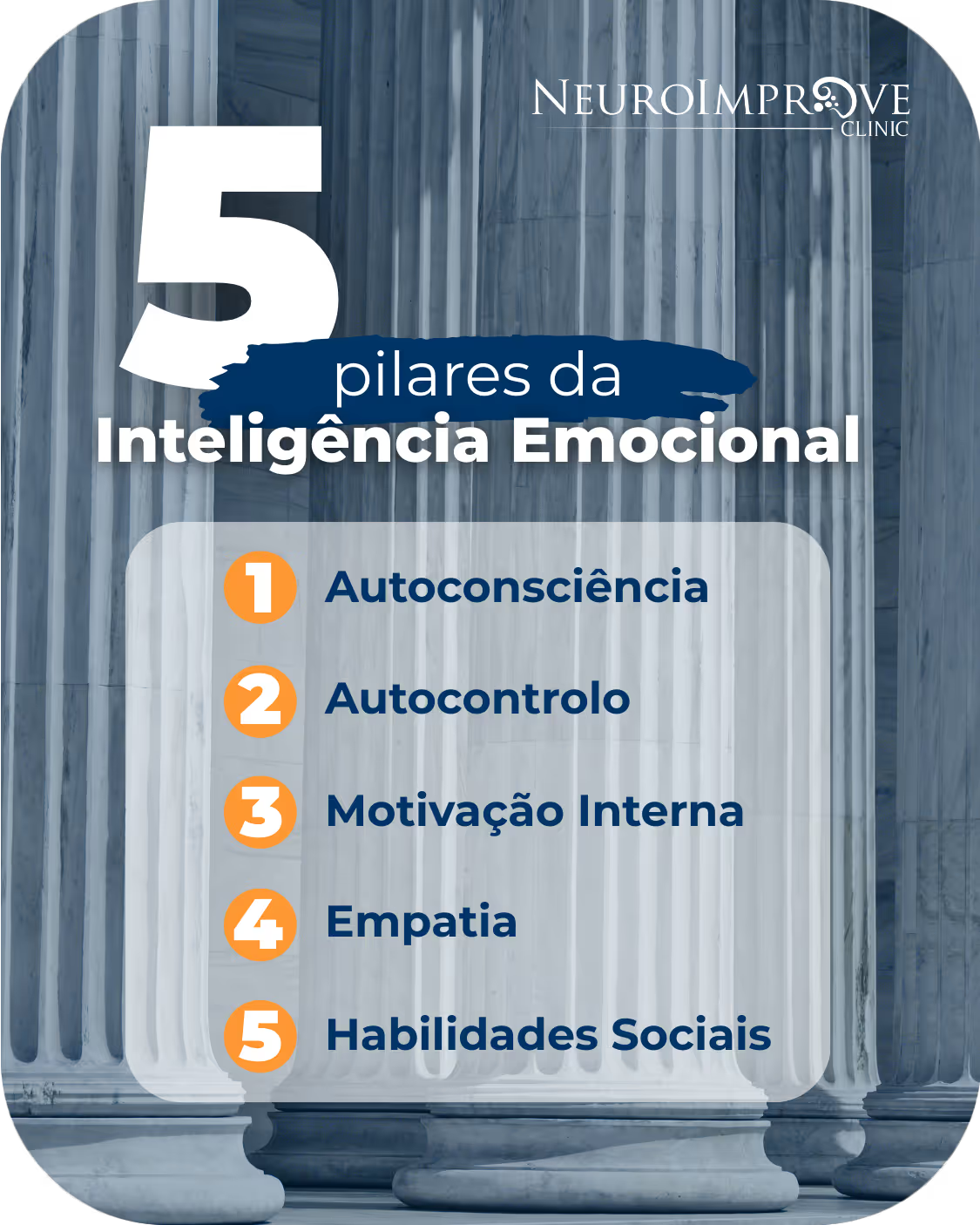
- Self-awareness
✅ It's a ability to recognize one's own emotionsand its effects, as well as to know its strengths and limitations.
- Self-control
✅ It's about ability to manage negative emotions and impulses, always maintaining calm, honesty and integrity. It also involves flexibility in dealing with change and being comfortable and receptive to new ideas and information.
- Internal motivation
✅ Consists of strive to improve or achieve levels of excellence, that is, to move by personal goals and internal values. People with Emotional Intelligence are also persistent in pursuing goals despite obstacles or adversities.
- Empathy
✅ To have sensitivity to the feelings and perspective of othersand have an active interest in their concerns, as well as being sensitive to what others need to develop and evolve their capabilities.
- Social Skills
✅ Includes one clear communication, conflict management, ability to work in a team and initiate/manage change.
These 5 pillars are fundamental to achieve a deep level of Emotional Intelligence understanding our emotions, those of others as well as their perspective, and above all of the events around us.
Final Considerations
Emotional Intelligence is a skill and above all an essential tool to live in a more conscious and balanced way. As we learn to recognize and manage our emotions,ganhamos clarezain our decisions, empathy in relationships and more resilience in the day to day.
Developing this capacity is something continuous which requires constant practice and reflection, but the benefits are quite obvious.Understanding what we feel and what others are feeling is critical to creating more authentic connections and a more purposeful life.
👉 The development of Emotional Intelligence can be monitored and guidedby professionals in the area, such as psychologists. Through the service of Clinical Psychology, we can help develop this competence. We have a team of psychologists ready to help you achieve your goals and a fuller quality of life.
References
Ferreira, F. O., Fonseca, M. E. S., & Nunes, A. L. from P. F. (2023). Emotional intelligence and its influences on conflict management. ID is online. Journal of Psychology, 17 (68), 219—231. https://doi.org/10.14295/idonline.v17i68.3863
Gonzaga, L., Sarmento, A., Caldeira, C. (2016). Emotional intelligence and optimism in adult subjects. UI_IPSantarém Magazine, 4 (2), 313—328. https://doi.org/10.25746/ruiips.v4.i2.9940
Serrat, O. (2017). Understanding and developing emotional intelligence. In Knowledge Solutions (pp. 329—339). Springer. https://doi.org/10.1007/978-981-10-0983-9_37

Related Content


We Train Brains, Strengthen Minds, Transform Lives
Schedule a consultation and see how we can help your family.
No time for a call now? Leave your details and we will get in touch:

Wonderful team, concerned, attentive and always available to help in everything.
With the passage of time, the results are being verified.
I am grateful to have met Neuroimprove and all its professionals.